No Code, or No Coders?
AI-Assisted Engineering vs. Autonomous Agents

I finally switched to Claude Code today -- I have been bouncing between Copilot, Cursor, Warp and Antigravity to get a feel for the landscape. I use VSCode Linux dev containers heavily, and so an extension-based mechanism is non-negotiable, which is why I landed eventually at Claude.
Anyway, I love supporting open source. (Too soon?)
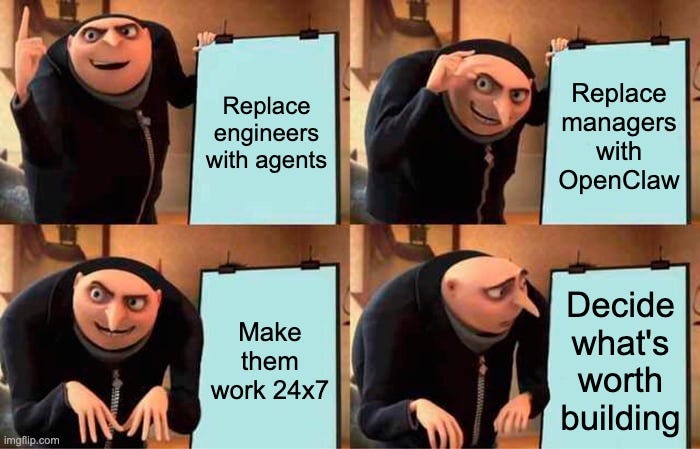
The shape of the debate is clearer and clearer. It’s AI-assisted engineering vs. autonomous agents. JustPaid is going the latter direction, using OpenClaw to orchestrate half a dozen agents. They cost $10K - $15K / month, and they are shipping features faster than the fractional engineer that amount would buy you in San Francisco ever could. Recently, one of my colleagues created a custom Claude agent team led by a product manager modeled on Gru with agents named after Minions.
I have no idea where his idea of a villainous product manager came from, by the way.
This is not to say it will be all-of-nothing for any company or individual. Tool usage is context-dependent. Prototyping is clearly heading in the no-coder direction: Design and Product will gravitate here. High-stakes, high-complexity engineering will be won by AI-assisted engineering because nobody wants to get into an MRI that was built by a former Figma designer with an agent team and a dream.
The contest will be in the vast middle ground of good enough.
Advances in tooling will increase autonomy’s safe operating range and collapse the marginal cost of adding automation to anything. It may well be that the middle ground balloons in size simply because it can, and absorbs all the AI tokens and visionary agent maestros on offer. I think there could be some legitimate worries about specific software companies, but the software industry will likely thrive in aggregate because things that were not worth automating at the previous price point will come in reach. Founders bearing ideas and the designs will still build companies, though they might not be as large as their predecessors. There will surely also be more instances of what VC’s scathingly refer to as “lifestyle businesses” — as opposed to the 100-bagger, VC-scale SaaS firms they covet.
Your average consumer mobile application, website, enterprise workflow-with-a-database IT system sits in the middle ground. Someone who can stretch the limits of creativity through great user interface design or a deep understanding of a business process can orchestrate agents to build it — and if the concept captures something truly valuable, will find success with that. Still, while we all would like to think we are fountains of creativity, this is something that’s very hard to amplify. (Though getting enough sleep helps.)
The good-enough middle’s operating model looks like this:
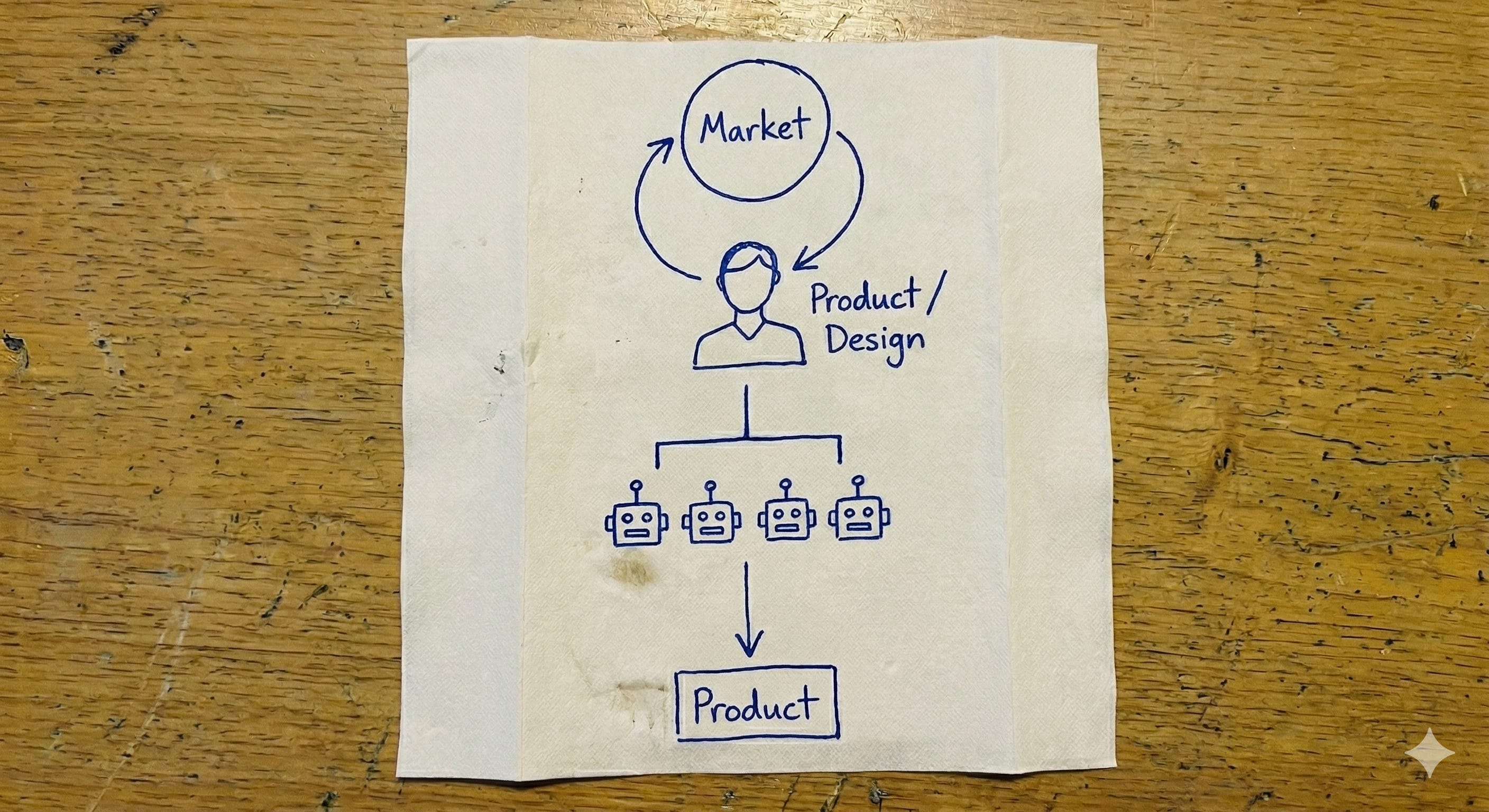
A founder or Product Manager / Designer directly interacts with an AI team to build the software product. This is the end-state of the JustPaid model. The primary competitive advantage is in the company’s relationships with design partners and early clients and its ability to convert that understanding — the concept for the product — into orchestrated action by the team. There’s just one problem: two can play that game. Good product managers infer the stated and revealed preferences of their competitors’ customers through competitive intel, interviewing for information, targeted hires, reverse engineering and more.
So the landscape is actually this after product-market fit is achieved:
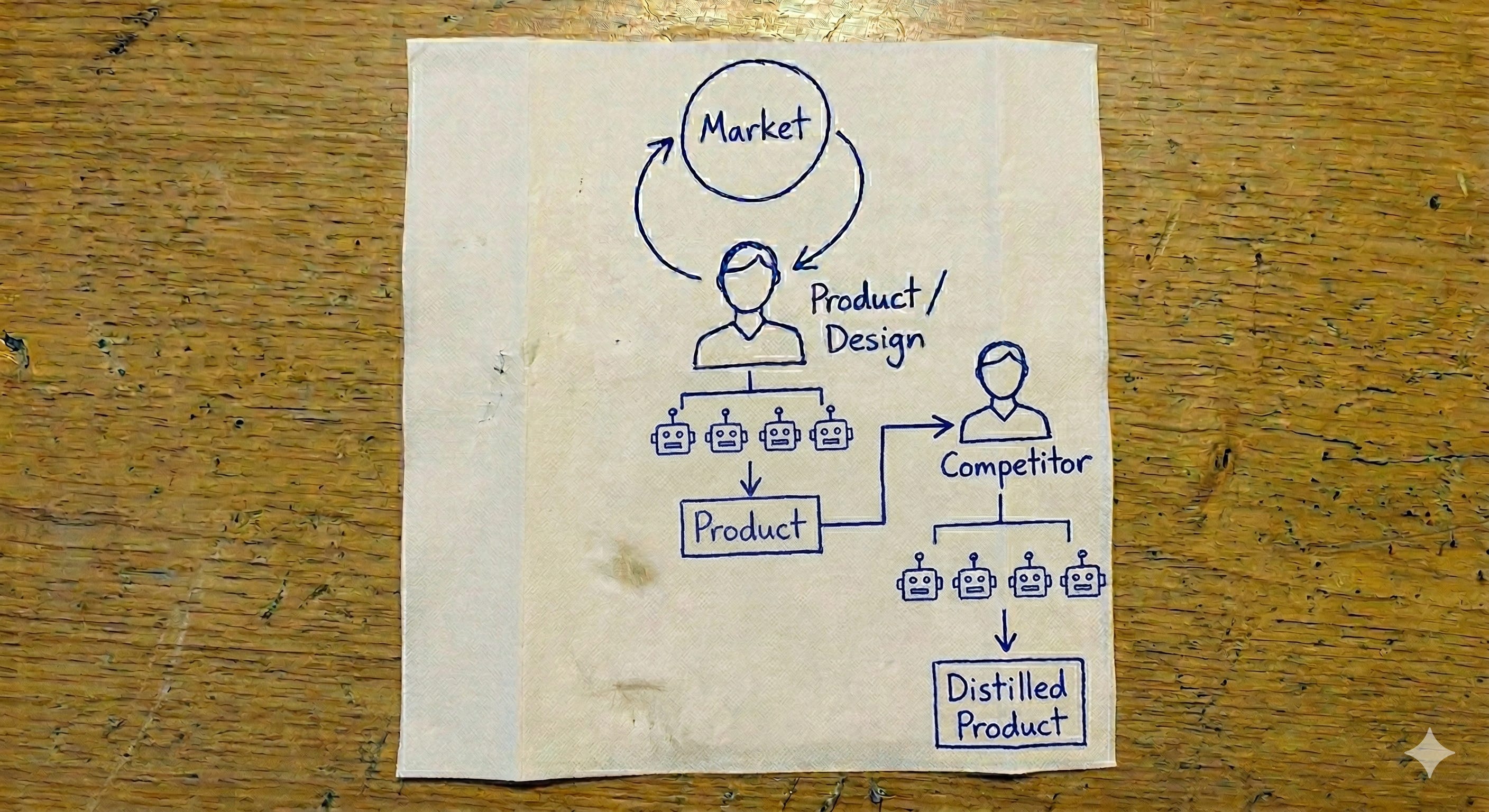
The competitor distills the conceptual model implied by what they learn about the Product and how the market is reacting to it, and does a very fast follow. This is a brutal game, and it rewards teams who are the very best at executing or with the surest supply of amphetamines and Chinese peptides. (NOTE: this blog post is not medical advice.) The biggest weakness in this model is that the innovative design of the product — great UX; novel features — is not a strong, sustainable advantage on its own. In a world where AI can screen-read a user interface and generate the code, to describe accurately is to create.
That means the particularly fertile corner of the frontier for AI-assisted engineering has to also hit the limits of time and space: scale, throughput, reliability, cost. A novel distributed database requiring a fraction of the memory of its predecessors; a 10X increase in compression for storage; a 5X reduction in time to execute fully homomorphic encryption; software to help explain and audit the thought process of a medical AI; an image processing algorithm that can work with consumer-grade optics rather NASA-grade; an agent able to trade reliably in sub-microsecond tick-to-trade environments; 100X leap in qubits for quantum computing; the next orchestration advance to take more of the middle ground — these kinds of problems are hard for developers acting alone but come within reach for more engineers when assisted by the top AI tools. You might look at the list and say these are not compelling or hard enough, but that’s good! Better tools should elevate ambition.
How does the model change if this is the approach? You get this — potentially scaled out with multiple PM’s and Engineers for the most complex software products:
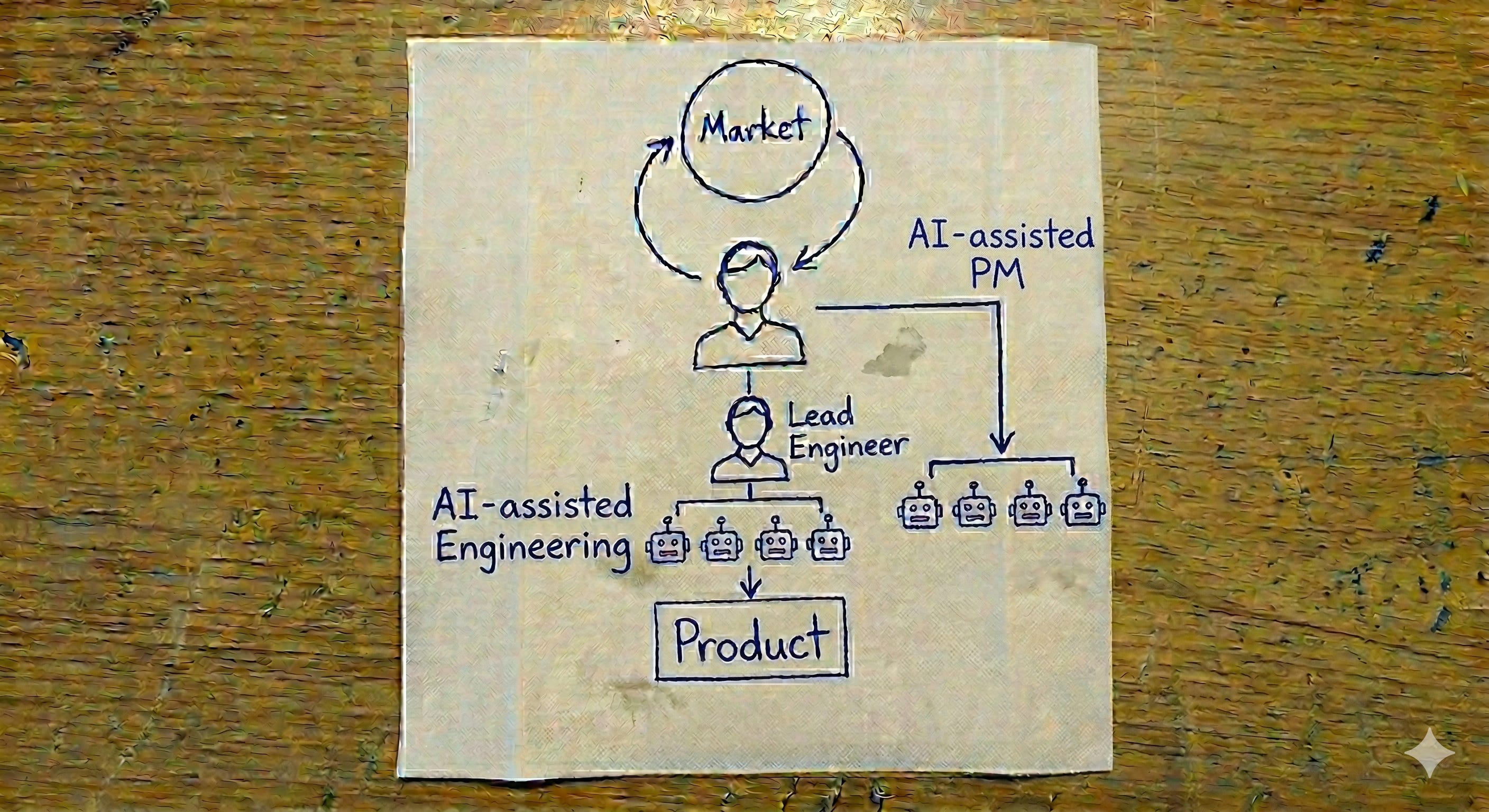
This competitive moat is double-hulled: it benefits from both the creative concept and relationships brought from Product / Design, and the ability of the Lead Engineer to push the AI team to the very limits. This is the deep tech playbook, and is far less vulnerable to all-against-all involution. You do not get here just having junior engineers with Claude accounts that let them ship features faster; this is Do the Hard Thing in action, engineers aiming for better and faster, and building ambitiously.
I am getting more optimistic the more I see out of the frontier labs and companies trying to apply AI. Not just about the impact of what they are building, but for individuals using them, and what they can accomplish. It’s an exciting time to be working in technology, and I am glad that my current role lets me work with a mix of teams (some non-technical) all trying to figure out how best to use these new tools.